


The challenge: an outdated system that could not support growth
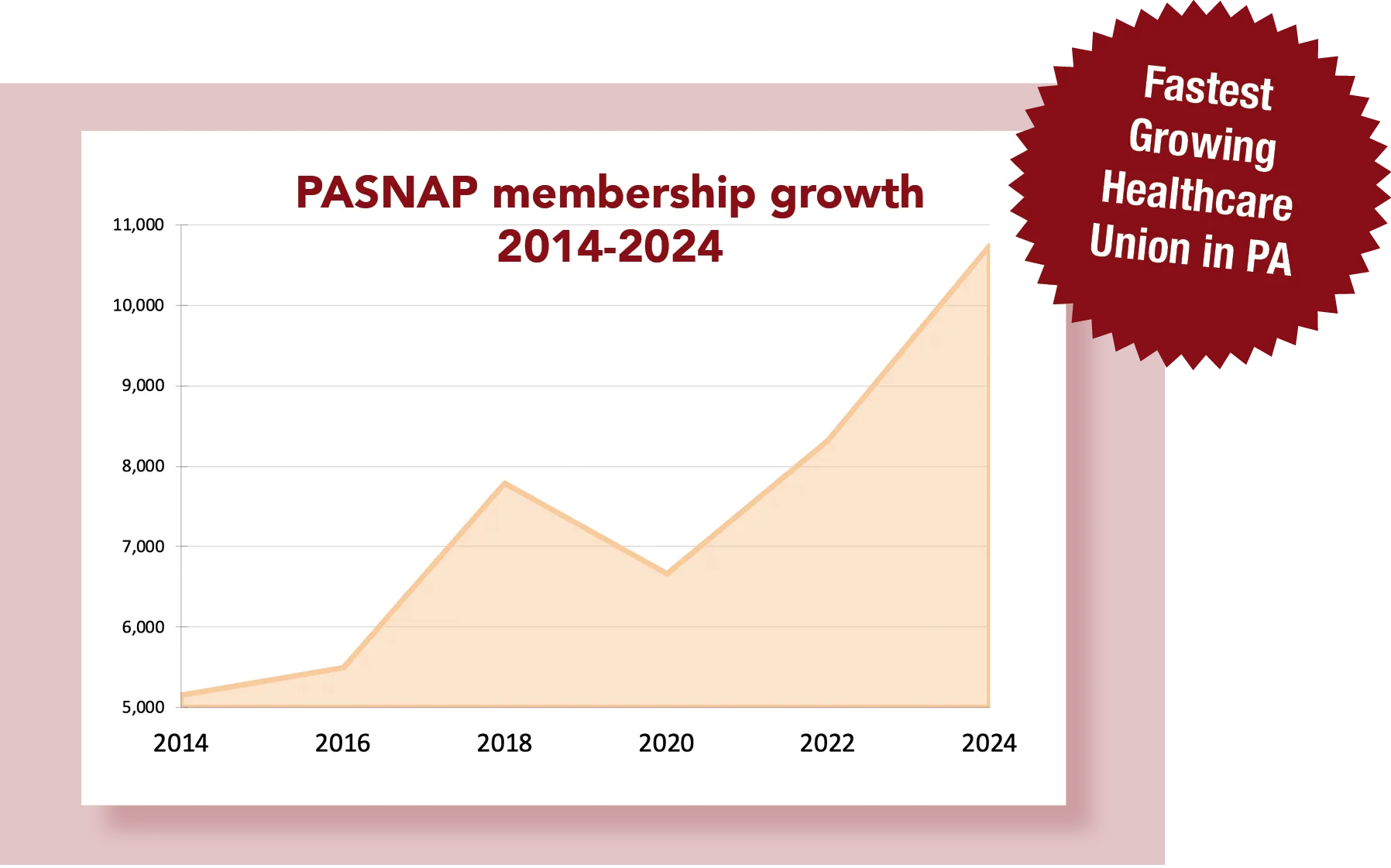
In 2014, PASNAP faced major growing pains. Since forming in 2000, the union’s organizing efforts were gaining momentum, and membership had grown to over 5,000 nurses and technical staff in hospitals all across Pennsylvania. However, their plans to grow had begun to face substantial technical challenges. The union’s custom-designed Microsoft Access database had served them well at first, but as they increased their membership and drafted plans to win new bargaining units, the shortcomings of the system were starting to hold them back.
One major issue centered around the fact that PASNAP ran both internal and external organizing campaigns. Their database had no way to partition these groups – even though their members had very different needs and the groups were considered separate entities by PASNAP. The intermingled records had become increasingly cumbersome to organizers and staff.
PASNAP’s staff also struggled with the legacy system’s UI and overall lack of features. On the internal organizing side, reporting was so limited that to get simple data like the current number of dues-paying members, staff had resorted to manually counting seniority reports. For new organizing, the system offered little insight into the priorities of the health workers they organized or the overall progress of their active campaigns. Strategy decisions like which shops might be receptive to collective bargaining or what issues to focus on were left to trial and error.
Finding a solution designed for labor
Knowing they needed to make some changes to continue to grow, PASNAP outlined their biggest organizational requirements and began to search for a solution that would support their plans to expand into new hospitals across Pennsylvania.
For new organizing, PASNAP wanted a way to store conversations and interactions with workers to find common complaints and track anything else that was important to the people they organized. Organizers also wanted a way to code workers more effectively, both to share what they knew about the temperament of the workers they spoke with individually and in aggregate – to better gauge the campaign’s overall progress.
On the internal organizing side, the needs were very simple. PASNAP had always prided themselves on their high contract standards – with a low member to rep ratio, they could serve members directly and keep issues from falling through the cracks. However, as the union grew, their data had deteriorated, and it had become difficult to generate a reliable list that showed who their current members actually were.
Like the external organizers, they also had a need for assessment coding and conversation notes to better understand and advocate for their members during contract negotiations.
As PASNAP used their list of requirements to shop for new technology, they quickly ran into difficulties finding a product that met their needs. As Ryan Melvin, Finance and Personnel Director at PASNAP explains, “with some of the databases we looked at, the features weren’t really available or you almost had to be a super-user to get that functionality out of them.” Another problem was vendors trying to shoe-horn what PASNAP needed into a general-use CRM. The union realized that what they really needed was an app specifically designed for labor.
“We’ve now had two campaigns where the difference between management’s eligible voter list and what we had in our database was less than 1%. I’ve been an organizer for decades and that’s unbelievable.”
 Stephanie SummersOrganizer, PASNAP
Broadstripes: a foundation for growth
When PASNAP found Broadstripes, they immediately saw a difference. “We’re a union who is constantly trying to grow so the organizing features of Broadstripes have a lot of appeal to the decision makers here. Broadstripes has been a foundation for us to build the union that we’ve become within the last 10 years,” says Melvin. “It’s a database created for organizers.”
Broadstripes also stood out because the features PASNAP needed were simple for staff to use. Melvin continues, “Broadstripes made it all easy and straightforward — because of Broadstripes’ user-friendliness, we could take any aspects of the database, put them together, and run a search based on those criteria.”
A solution that fully supports internal and external organizing
When PASNAP migrated to Broadstripes, they were also able to immediately move internal and external organizing into their own separate projects so the data was no longer intermingled. This issue was one of the initial reasons they left their legacy system, and solving it was a huge relief. It also allowed the union to start using Broadstripes in more nuanced ways, starting with collecting data that truly met the needs of each organizing group.
Stephanie Summers, an organizer at PASNAP, says that being able to configure Broadstripes to exactly match the complicated workplaces she organizes is one way the app sets them up for success in new organizing. Each hospital, Summers explains, might have sixty or more departments, creating a real organizing challenge — unless you begin with an accurate picture of the shop structure. Now they start a campaign by setting up Broadstripes to precisely reflect every department in the hospital.
Says Summers, “Broadstripes helps us know that we’re not missing any departments and that we’re working from accurate information from the beginning. It ensures that we’re not inadvertently blindsided by something later in the campaign.”
Melvin says Broadstripes’ ability to log and share detailed worker information has also been crucial to their growth. “Broadstripes’ contact timeline and notes are essential in terms of capturing conversations into the new organizing side. These features, and also the ability to code workers, were very influential in the decision to move to Broadstripes. You really need to know where people stand when you’re trying to organize.”
Summers agrees, and says that Broadstripes starts informing their campaigns very early in the process. From the beginning of a campaign, she says, “it helps us establish what the size of the eligible voter pool might be – before we even have a list from management. In new organizing, we typically use whatever information workers give us about the eligible voters in their departments, so we can envision a worst case scenario and then build to our strengths prior to filing.”

Getting to know workers’ needs
Melvin expands on this, explaining that Broadstripes can also capture workers’ attitudes by location at a very granular level. Organizers are now “constantly improving their understanding of hospital work environments across Pennsylvania,” he says. “They enter whatever they find out into the database, so we’ll have records from all kinds of people at different hospitals — even if it’s not something we pursue now, it might be down the road.”
In addition to supporting new organizing, Broadstripes offers benefits to PASNAP members who are already part of an established bargaining unit, too. PASNAP’s internal organizers are using Broadstripes to unite around the contract, sign up new people, and, Melvin says, “gauge important issues from the workforce like ‘What do we need to address for the next contract?’ ‘What has management been doing wrong lately?’ and ‘What do we need to do to fix that?’”
Staff reps. use the database primarily to maintain the membership at the shop, so Broadstripes’ coding features are key. Melvin says they also use the contact timeline to “see if anybody’s ever talked to a certain worker before and how that conversation went. All this is very helpful information and gives them a sense – before they even talk to someone – of where they stand or how their temperament is going to be.”
Data accuracy “improved tremendously”
Purging bad data and having a more accurate way to keep track of current union members was another key reason PASNAP left their legacy system. “Accuracy has improved tremendously,” reports Melvin, whose work has him looking at large sets of data on a daily basis. “To see dues-paying members, now I can just run a search in Broadstripes to see that — and the list is 99% accurate without having to go through all the work of counting everybody head by head.”
Melvin also queries Broadstripes often to find places where an employer might have made a mistake. “There are all kinds of things that can slip through the cracks,” he explains. The union gets monthly change/hire/termination reports as Excel files which they upload into Broadstripes and compare to their periodic seniority list. “We find the discrepancies, and send them to the boss to keep them honest,” says Melvin.
In cases where this work uncovers an employer that’s neglected to deduct dues, Melvin says PASNAP will recoup what is owed directly from the hospital. “We are holding the boss accountable – and Broadstripes has been able to help us do this way more often than we could have on our own. Whenever we can get the employer to pay our members’ dues, it’s a huge win.”

Summers confirms there’s been real improvement in data accuracy from the organizer’s perspective as well. “We’ve now had two campaigns where the difference between management’s eligible voter list and what we had in our database was less than one percent. I’ve been an organizer for decades and that’s unbelievable.”
Continuing to grow with digital membership cards
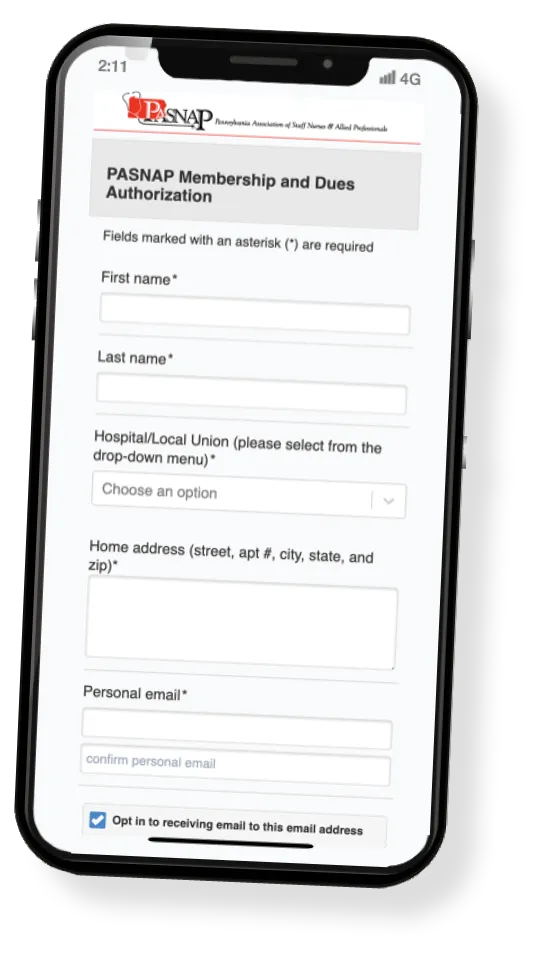
Now that PASNAP can fully trust their data, the union has begun to find new ways to use Broadstripes. One example is moving to digital membership cards, which Melvin says is “probably one of the best things we’ve done with Broadstripes so far. We’re very happy.”
The union’s previous solution for collecting signed cards online was homegrown – the cards could be signed digitally, but there were a lot of touches to get the information where it needed to go. Explains Melvin, “it was an arduous process, and there were also a lot of typos and bad data coming in.”
PASNAP approached Broadstripes to create a custom solution. “We came to Broadstripes asking what they could do for us because we knew there was a better way to do this,” explains Melvin.
They were not disappointed. “This solution is very helpful in a lot of different ways,” he says. Members can now sign a card from a phone or other web-enabled device. When a worker signs, they are required to select the shop where they work from a prefilled list of options that Broadstripes pulls directly from PASNAP’s database. “That’s a key feature,” Melvin says, “so data integrity is maintained.”
Built-in automation increases staff efficiency
Melvin also notes that Broadstripes’ new online membership card has been “one of the biggest things we’ve done to free up time for our staff.” Once a worker signs a card, Broadstripes automatically emails the employer based on the shop they indicated. It also emails the worker a receipt and automatically creates a contact record for them in Broadstripes, eliminating the need for data entry by staff reps.
The automated system has the added benefit of keeping employers in line. Explains Melvin, “This has been a very effective tool—we use check off, so the CBA agreement at each of our locals has dues paid through payroll deductions. There are a lot of rules around that, but we are doing it effectively, and Broadstripes allows us to check up on the process and make sure the boss is doing it right, too.”
When the email goes to the employer, he explains, “not only are we immediately notifying them that somebody signed up, but we have a receipt of it and we have something that’s legally binding and actionable in legal terms. This means if we go back and see that a person didn’t have dues deducted, we can take that up with the employer and there’s a real paper trail.”
As an organizer, Summers praises another aspect of Broadstripes’ time-saving automation – a new set of tools that lets organizers send personalized emails and texts to whole groups of workers at one time.
Emailing and texting directly from Broadstripes “has been very helpful for sending out something universally,” especially, Summers says, “in a situation when I want to immediately respond to something management has said.” She says she’s also started to use text and emails to communicate with people post-bargaining. “I might have a Zoom call,” she says, “and all the attendees are there because I emailed them about that meeting.”
Although she has used many databases and other tools during her career as an organizer, Summers says she thinks that Broadstripes is also “really great for people who don’t have a lot of database experience.” Another thing she appreciates is how much information Broadstripes makes accessible to her teammates through the cloud. “It’s being updated in real time for whoever might be using it – that’s great.”
Data for making smarter campaign choices
PASNAP set out with the goal of growing their membership, but one key to their unbelievable success may be their own ability to grow as organizers. Since adopting the system ten years ago, PASNAP staff has come to depend on Broadstripes’ high-level analysis to guide their strategy decisions and help organizers pivot and change their approach — often multiple times over the course of a single campaign.
Summers explains, “I’ll use a status report to give us our day by day eyeball of where we are in the campaign.” She adds that because Broadstripes can show campaign progress by department, “if we’re, say, running a petition, it can tell me in a second where the percentage is low and we need more work done, where we’re doing really well, and what our overall numbers really are at that moment.”
All of this translates into better and more nimble organizing. “We make determinations and decisions about campaigns based upon the strength of our support, so having the ability to look at that quickly through a status report – it’s really helpful.”
Broadstripes has been a “hugely effective organizing tool”
When asked to revisit the choice to move to Broadstripes ten years ago, Melvin is unhesitating with his praise, “Broadstripes has been a hugely effective organizing tool. We’ve also been able to use it to great success to run effective membership drives.”
Melvin says he looks at where his shops are in terms of membership percentage in Broadstripes on a regular basis and offers some quick numbers to support the claim, “Our membership at our biggest shop is at 97%,” which, he adds, “for a shop that’s 1,700 people, is just amazing.”
“That’s a testament to both our staff and what Broadstripes has been able to bring to the table for us,” says Melvin. “We would never be able to get to 97% – or even know that we had reached that number – without Broadstripes.”